How to Choose the Right Salmon River Rafting Trip for You

Discover What Sets Idaho’s Middle Fork, Main Salmon, and Lower Salmon River Trips Apart
The Salmon River is a treasure trove. From world-class whitewater and blue-ribbon trout fisheries to hot springs, historic homesteads, and sprawling white-sand beaches, it’s one of North America’s premier rafting destinations.

Flowing 425 miles through the heart of central Idaho, the Salmon is the longest undammed river in the contiguous United States. Much of its journey winds through the vast, 2.3-million-acre Frank Church–River of No Return Wilderness. Along the way, the river drops more than 7,000 feet from its headwaters to its confluence with the Snake River, carving through an extraordinary range of landscapes, from high-country forests and granite canyons to rolling grasslands and high-desert terrain.
As a result, the Middle Fork, Main Salmon, and Lower Salmon each have their own unique personality and offer a markedly different blend of whitewater, scenery, recreation, and history.
Explore River Stretches: Middle Fork Salmon | Main Salmon | Lower Salmon
Middle Fork of the Salmon
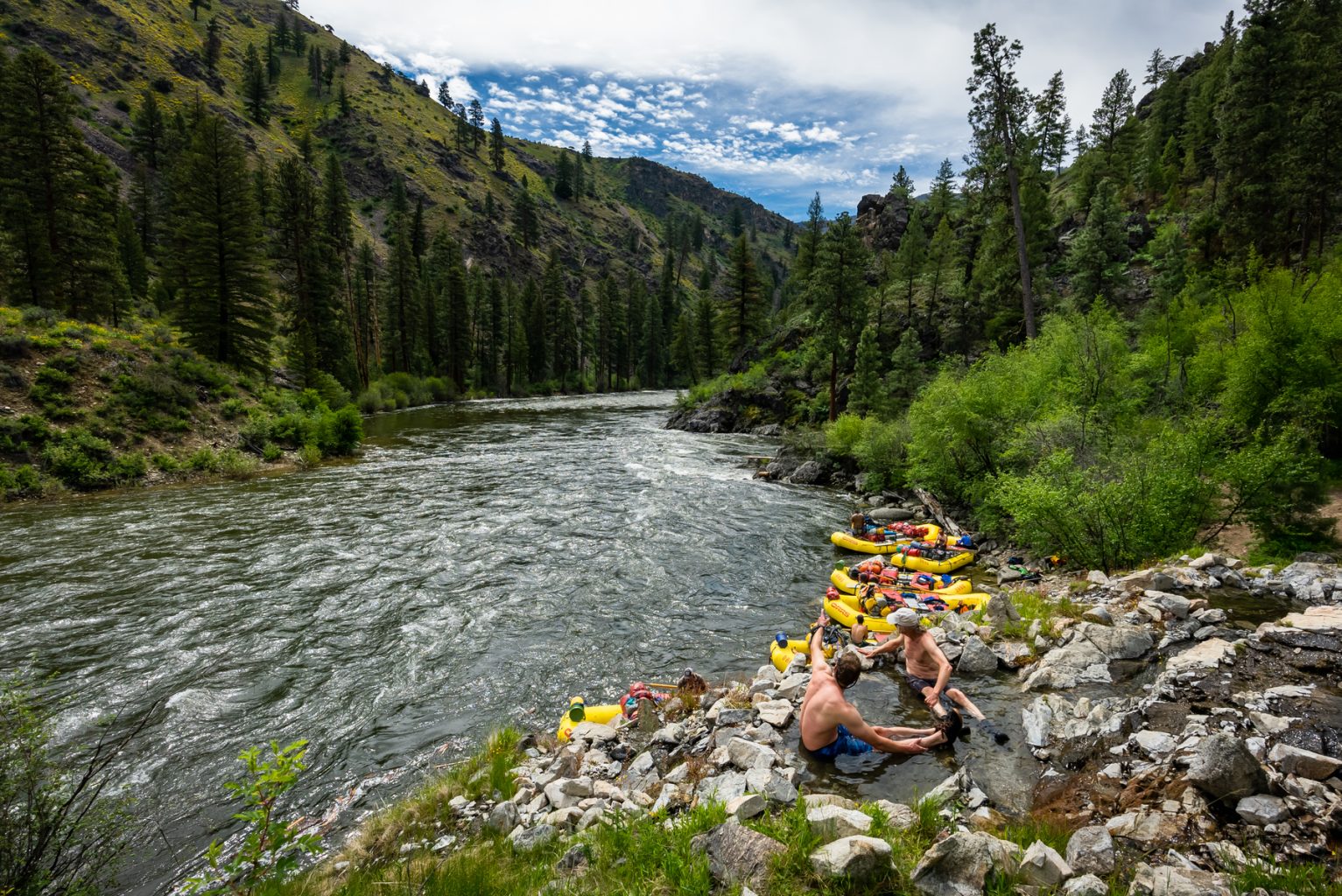
The Middle Fork Salmon starts high in the Sawtooth Mountains. Its crystalline waters plunge through high-country forests, sharp granite canyons, and sweeping grasslands. The first 25 miles drop 40 feet per mile (fpm), and the rest of the river averages an impressive drop of 23 fpm. This steep gradient creates more than 100 rapids in nearly 100 miles, making the Middle Fork the most challenging and continuous whitewater experience on the Salmon River.
It is most adventurous in the early season, with the biggest waves and colder temps. As the water drops, the hydraulics become smaller, but the rapids get more technical. Passengers can ride in an oar boat or opt for a more thrilling experience in a paddle raft or inflatable kayak.
But the Middle Fork isn’t only about adrenaline. It’s also one of the premier catch-and-release fly fishing destinations in the country, with natural hot springs, waterfalls, Indigenous pictographs, and a rich cultural history woven throughout the canyon. Add in exceptional hiking opportunities, and it’s easy to see why the Middle Fork is one of the most sought-after rafting trips in the U.S.
Trip Highlights
- Navigate legendary rapids like Hell’s Half Mile, Velvet Falls, and Pistol Creek before plunging into the famed Impassable Canyon, home to classics such as Rubber, Devil’s Tooth, and House of Rocks
- Soak riverside at Sheepeater, Sunflower, and Loon Creek Hot Springs
- Stretch your legs on hikes to Camas Creek, Veil Falls, and Nugget Creek, or explore sections of the historic River Trail that parallels the canyon
- Cast to wild Westslope cutthroat trout in one of the nation’s premier catch-and-release fisheries, renowned for exceptional dry-fly fishing
- Discover pictographs, pit house sites, and rich Indigenous history throughout the corridor
- Watch for bighorn sheep, deer, black bears, and river otters
Why Choose the Middle Fork?
Choose the Middle Fork if your priorities are Class IV whitewater, hiking, fishing, and immersion in a remote wilderness setting.
Middle Fork Salmon Quick Stats
Trip Length: 6 days / 5 nights
Distance: 95 miles (70 miles from Indian Creek)
Whitewater: Class III-IV
Put-in: Indian Creek (via scenic flight) or Boundary Creek | Take-out: Cache Bar
Meeting Place: Stanley, ID or Salmon, ID | End: Salmon, ID
Main Salmon

The Main Salmon strikes a balance between excitement and relaxation. At an average gradient of 12 feet per mile, the river flows in a classic pool-drop rhythm: fluffy wave trains are followed by large, meandering pools, perfect for peaceful scenic floating or a nice, refreshing dip.
As summer progresses and water levels recede, the Main’s beautiful white-sand beaches grow more expansive, creating idyllic campsites and endless opportunities for riverside fun. The canyon is equally rich in history, with Indigenous pictographs, historic homesteads, mining relics, and stories of the people who once called this remote corridor home.
For those seeking a more active experience, paddle rafts, inflatable kayaks, and stand-up paddle boards offer plenty of excitement. Or, for a truly classic ride, step aboard a historic hard-hulled dory.
Trip Highlights
- Run classic Main Salmon rapids including Black Creek, Big Mallard, Elk Horn, Chittam, and Vinegar Creek
- Try stand-up paddleboarding or paddle an inflatable kayak
- Soak in Barth Hot Spring, tucked along the banks of the river
- Hike to Bargamin Creek and explore the rare Yew Grove at Indian Creek
- Visit historic sites including Campbell’s Ferry, Jim Moore Place, Buckskin Bill’s Museum, and Polly Bemis Ranch
- Discover Indigenous pictographs and traces of the canyon’s long human history
- Watch for bighorn sheep, families of moose wading in the river shallows, and river otters
Why Choose the Main Salmon?
Choose the Main Salmon if you’re looking for the classic Salmon River experience—a balance of whitewater (and dories!), sandy beaches, history, and relaxation that appeals to nearly every type of river runner.
Main Salmon Quick Stats
Trip Length: 6 days / 5 nights
Distance: 81-92 miles
Whitewater: Class III (with 2-5 Class IV rapids depending on water level)
Put-in: Corn Creek | Take-out: Carey Creek or Spring Bar (depending on water level)
Meeting Place: McCall, ID, scenic flight to Salmon, ID | End: McCall, ID
Lower Salmon

The Lower Salmon is the warmest and most approachable section of the river. Here, the landscape oscillates between wide-open rolling hills with sweeping river bends and dramatic gorges with sheer cliff walls, creating scenery that feels distinctly different from the upper reaches of the Salmon.
As the river funnels through Green Canyon, Cougar Canyon, Snowhole Canyon, and Blue Canyon, it forms a series of splashy rollercoaster rapids that feel more playful than intimidating. Guests can ride in an oar raft or dory, participate in a paddle raft, try a stand-up paddle board, or paddle an inflatable kayak for a more hands-on adventure. At camp, warm eddies and broad sandy beaches—rivaling those of the Main Salmon—invite swimming, camp games, and lazy afternoons along the water’s edge.
The Lower Salmon’s shorter itineraries and warm summer conditions make it especially popular with first-time rafters and families. Yet the scenery, whitewater, and relaxed pace appeal just as strongly to returning river runners looking for a fun, carefree wilderness getaway.
Trip Highlights
- Splash through favorite rapids including Demon’s Drop, Bodacious Bounce, Snow Hole, China, and Eye of the Needle
- Try stand-up paddleboarding or paddle an inflatable kayak
- Hike to viewpoints above Blue Canyon and explore tributaries like Maloney Creek
- Discover Indigenous pictographs, petroglyphs, and historic Chinese mining structures
- Fish for smallmouth bass throughout the season
- Spot bighorn sheep, mule deer, along with eagles, ospreys, and golden eagles soaring above
Why Choose the Lower Salmon?
Choose the Lower Salmon if you’re looking for warm water, playful rapids, a shorter itinerary, and one of the best introductions to multi-day rafting anywhere in the West.
Lower Salmon Quick Stats
Trip Length: 4 days / 3 nights or 5 days / 4 nights
Distance: 73 miles
Whitewater: Class III (with 1-3 Class IV depending on water levels)
Put-in: Hammer Creek | Take-out: Heller Bar
Meeting Place: Lewiston, ID | End: Lewiston, ID

Still can’t decide which Salmon River rafting trip is right for you?
The Salmon River offers something no other commercial rafting trip in the United States can: the opportunity to experience an entire river system, from its cold, fast-moving mountain reaches to its warm, beach-lined lower canyons.
By linking multiple sections together—or tackling all three on a single 17-day “Ultimate Salmon River” expedition—rafters can follow the Salmon for more than 300 miles through the heart of Idaho. Along the way, alpine forests give way to grasslands, granite canyons transition to basalt gorges, and each stretch reveals a new side of one of North America’s great wilderness rivers.
The longer you spend on the Salmon, the more the river reveals itself—and the more unforgettable the experience becomes.
Sign up for Our Newsletter